

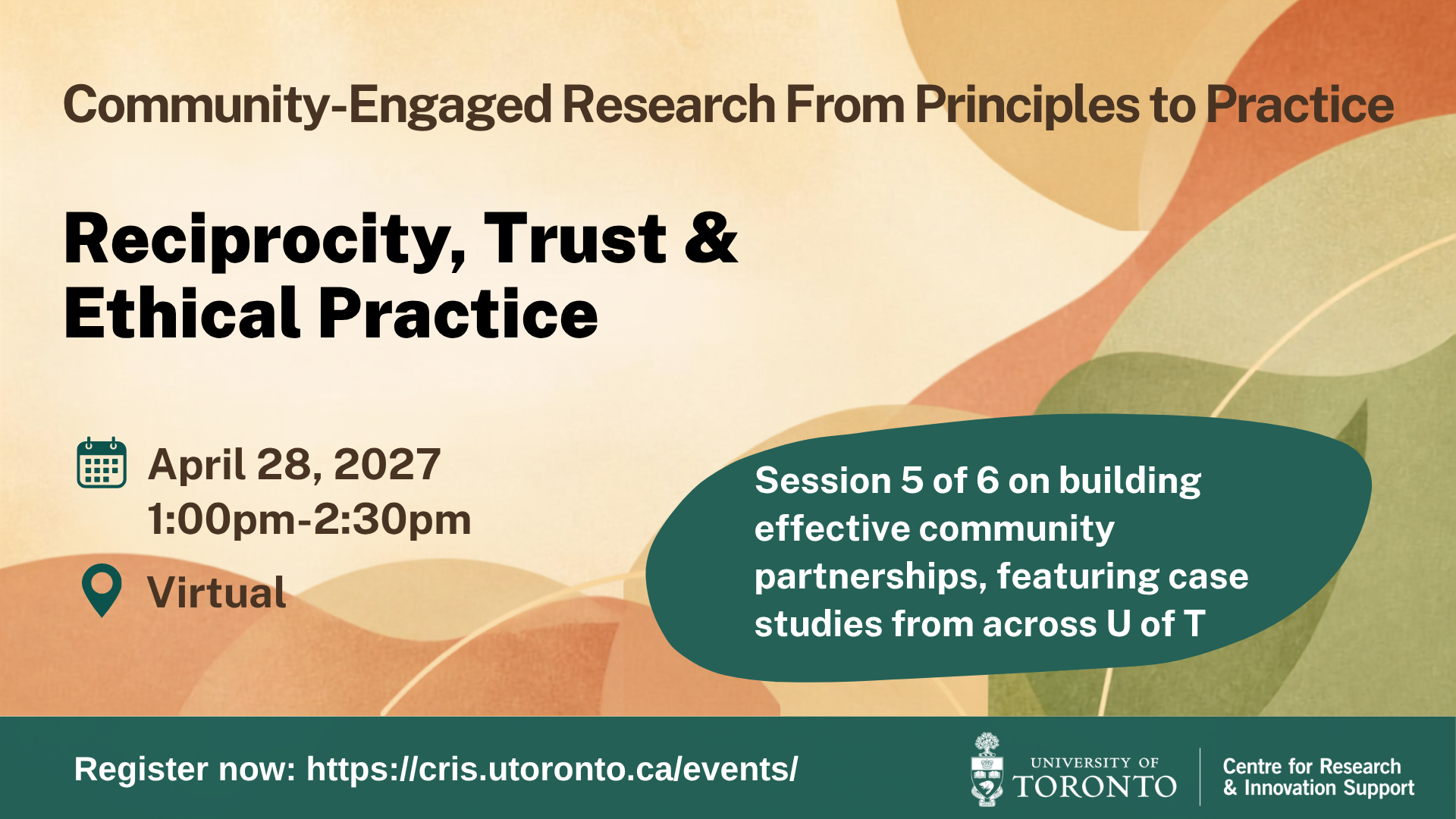
Community-Engaged Research from Principles to Practice 5: Reciprocity, Trust, and Ethical Practice – Apr. 28, 2027
Session Description
April 28, 2027 @ 1:00 pm - 2:30 pm
Support for community autonomy, shared interpretation of findings, and a fair distribution of burden and benefit are what make community research partnerships ethical and sustainable.
Join us for Session 5 of Community-Engaged Research from Principles to Practice, a six-session virtual series that gives researchers and community partners a practical, evidence-based foundation for building research partnerships with communities.
This session builds understanding of the ethical principles specific to community-engaged research, and the practical tools researchers can use to build trust and share power with community partners.
It can be completed as a standalone workshop, though we encourage participants to complete the full series for a comprehensive foundation in community-engaged research in order to receive the Certificate of Series Completion.
Developed by the Institute for Translational Sciences at the University of Texas Medical Branch and adapted by CRIS for the Canadian context and for researchers across all disciplines, each session combines interactive presentations, case studies from U of T researcher-community partnerships and facilitated peer discussions.
Moderator:
Dr. Barbara Fallon, Associate Vice-President, Research, VPRI; Professor, Factor-Inwentash Faculty of Social Work
Presenters:
Claire Hallmark, Program Director, Community Outcomes & Evaluation, Institute for Translational Sciences, The University of Texas Medical Branch
Dr. Sharon Croisant, Professor Emeritus, School of Public and Population Health, University of Texas Medical Branch
Dr. Lance Hallberg, Program Director Environmental & Public Health Education and Engagement, University of Texas Medical Branch
U of T Guest Case Study Presenters:To be announced
Learning Objectives
By the end of this session, participants will be able to:
- Describe the ethical dimensions and principles of community-engaged research, including fair distribution of burden and benefit for research partners and the affected community
- Identify approaches and tools to evaluate and improve the collaborative process
Additional Information
Intended audience:
This series is open to the University of Toronto and TAHSN faculty interested in building their community-engaged research competencies and their research teams. We welcome and encourage researchers to invite community partners to participate. Members or collaborators of the same team or project should register individually.